

The Covenant of the Beloved
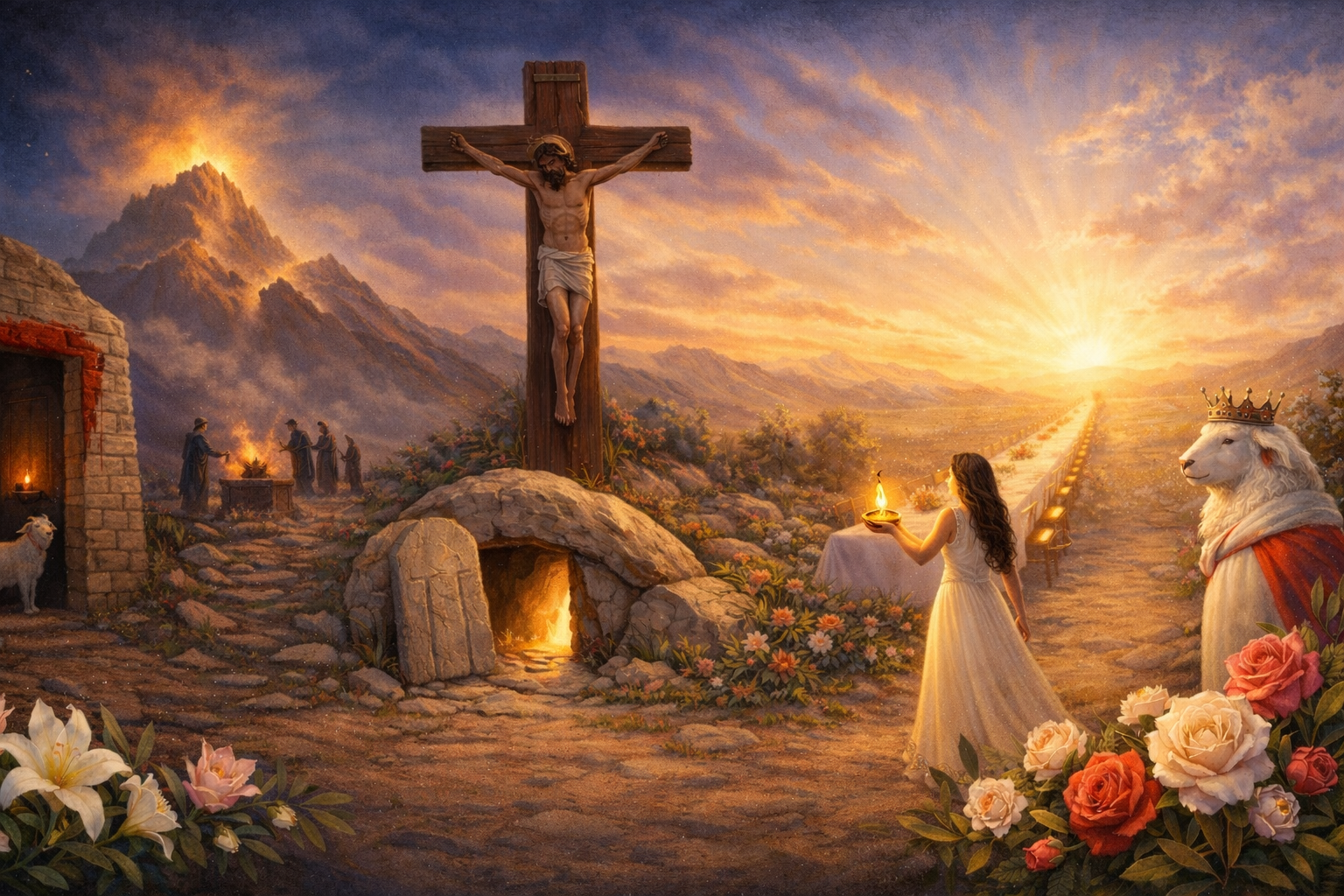
The Journey of the Bridegroom and His Bride by Rebecca Lane via GPT
Prologue: Orchestration of the Ages
Sometimes, the Holy Spirit pulls back the veil to show us that our studies are not a series of random chapters, but a divine appointment with the King. This week, as we sat together at The Quiet Table, a tapestry began to unfurl—one that started in the dusty plains of Moab with Moses, moved through the upper room in Jerusalem, and finds its ultimate, thunderous conclusion in the halls of the New Jerusalem.
As a studier of the Word, you know that God is never haphazard. When He speaks of an appointed time, He is not merely marking a calendar; He is revealing a divine declaration. This project, The Secret Place, was birthed in the quiet of the studio, but its roots are anchored in the most rigorous legal and covenantal structures of the Old Testament and the prophetic promises of the New. To understand the intimacy of the Beloved, we must first understand the Covenant that bought His bride. We cannot truly appreciate the "Secret Place" of Song of Songs 2:14 until we have stood at the doorpost in Exodus 12 and seen the blood that makes that intimacy possible.
What was so profound Saturday morning was the realization that the Lord was aligning our study of Deuteronomy 16 and Matthew 26 to show how the Lord works in Spirit and Truth. The King who calls us to the garden is the same King who walked the lonely path to the cross, and He is the same King who stands as the Lamb in Revelation 19. The "Secret Place" is the rehearsal for the Wedding Feast.
The story we are walking through is the story of the Lamb who was inspected, the Bridegroom who proposed, and the Bride who is preparing for His return. It is a journey that moves from the blood of the sacrifice to the wine of the Kingdom—from the appointed time (moed) of the Law to the eternity of the Marriage Supper. If we miss Revelation, we miss the "why" of the Passover. We don't just study to know facts; we study to be a Bride who has made herself ready (Revelation 19:7).
The "Secret Place" is not a destination we find through our own wandering; it is a place of intimacy prepared for us by the King. Before the Beloved can invite us into the cleft of the rock, He first establishes the legal ground for our meeting. In the economy of the Kingdom, intimacy always follows atonement. To understand how we enter His presence, we must look at the "Physical Theology" of the Old Covenant, where God carefully chose a specific location to place His name (and His authority). We see this architecture of grace beginning in the plains of Moab, where the Lord defines the "Place of the Name"—the only ground where the sacrifice could be offered and where the Bridegroom and His bride could finally be met.
Act I: The Appointed Place (Deuteronomy 16)
The Geometry of the Appointed Time
Our journey begins in the plains of Moab. Moses is delivering his final addresses to a generation about to enter the Promised Land. In Deuteronomy 16:1-2, the language is startlingly specific:
"Observe the month of Abib and keep the Passover to the Lord your God, for in the month of Abib the Lord your God brought you out of Egypt by night. And you shall sacrifice the Passover sacrifice to the Lord your God, from the flock or the herd, at the place that the Lord will choose, to make his name dwell there."
There are three pillars here that are essential to the Gospel and the final vision of Revelation: The Appointed Time (The Moed), The Source (The Flock), and The Place (The Name).
The Moed: The Calendar of the King
The word for "appointed time" is moed (מוֹעֵד). In Hebrew thought, a moed is a divine appointment—a tent of meeting in time. By commanding the Passover in the month of Abib (later known as Nisan), God was tying spiritual redemption to the physical reality of the land's rebirth.
But there is a deeper layer of sovereignty here. Israel was not permitted to sacrifice whenever they felt a surge of emotion. They were to sacrifice when the King called the meeting. We see the fulfillment of this precision in Matthew 26. The religious leaders had their own "human" calendar. They said, "Not during the feast." But Jesus, the Master of the Moed, declared: "You know that after two days the Passover is coming." This precision points directly to the "Midnight Cry." Just as the Passover happened at an appointed hour, and the Cross happened at an appointed hour, the Wedding of the Lamb is an appointed moed. The Bridegroom is not delayed; He is moving according to the Father's calendar.
From the Flock: The Kinsman Redeemer
Deuteronomy 16 specifies the sacrifice must come "from the flock." Why? Because the substitute had to be one of them. To pay the debt of the people, the substitute had to be related to the people.
This is the foundation of our intimacy. Christ didn't just hover over our pain; He was "taken from the flock" of humanity. This is why in Revelation 5, the only one found worthy to open the scroll is the Lamb who was slain. He is worthy because He is the Kinsman. He is of our flock, yet He is our King. He shared our flesh so that we could share His glory.
The Place That Bears His Name
In Deuteronomy 16:2, the sacrifice must be at the place the Lord will choose, to make His Name dwell there.
Under the Old Covenant, you had to go to the Name. In the ancient world, to have someone’s "name dwell" somewhere was to have their full legal presence and authority there. Jesus is the Place that the Lord has chosen. When He died in Jerusalem, He was fulfilling the geography of Deuteronomy.
But look at where this ends: In Revelation 22:4, it says of the Bride, "They will see his face, and his name will be on their foreheads." The goal of the Passover sacrifice was to bring us to the place where the Name dwells, but the goal of the New Covenant is to make us the place where the Name dwells eternally. That is no small thing!
Act II: The Inspected Lamb (Exodus 12 & 22)
The Four-Day Dwelling
In the original institution of the Passover in Exodus 12, God gave an instruction that seems almost counterintuitive if the goal was merely a quick sacrifice:
"On the tenth day of this month every man shall take a lamb... and you shall keep it until the fourteenth day of this month, when the whole assembly of the congregation of Israel shall kill their lambs at twilight."
For four days, the lamb was taken from the flock and brought into the home. It lived among the people. It was no longer a distant animal in a field; it was observed, known, and intimately inspected. During these four days, the family had to ensure the lamb was Tamim (תָּמִים)—translated as "without blemish," but meaning something far deeper: whole, complete, and blameless.
The Fulfillment in Matthew 21–26: The precision of the Holy Spirit is breathtaking when we look at the Passion Week. Jesus entered Jerusalem (the "House" of the Father) on the 10th of Nisan. For exactly four days—until the 14th of Nisan—He was subjected to the most intense "inspection" in human history.
He was not hiding in a corner; He was in the Temple courts, the very "place where the Name dwells." During these four days, every major power structure of the day "inspected" the Lamb:
The Pharisees tested Him on the Law and tax.
The Sadducees tested Him on the Resurrection.
The Lawyers tested Him on the Greatest Commandment.
The Sanhedrin interrogated Him.
Pilate examined Him twice.
Each "inspector" was forced to reach the same conclusion. Even Pilate, the representative of Roman justice, had to declare: "I find no guilt in Him." The Lamb was pulled from the flock of humanity, lived among us, was inspected by us, and was found perfectly Tamim. He did not just "happen" to die at Passover; He was the only one qualified to die because He was the Messiah and the only one who could pass the inspection.
This inspection was not a mere formality; it was a verification of value. In the ancient world, a sacrifice had to be worth more than the debt it was intended to cover. By proving that Jesus was perfectly Tamim—without spot or blemish—the Father was demonstrating that this Lamb possessed the spiritual "capital" necessary to settle the greatest legal claim in history. The price to cover our sin. This leads us from the home of the Passover to the courtroom of the Law, where a specific type of payment was required to set the captive free.
To be Tamim was not just a measure of physical perfection; it was a measure of relational proximity. By dwelling in the home, the lamb’s blamelessness was witnessed in the context of daily life. This reminds us that our Savior didn't just qualify for the Cross in a vacuum; He qualified by living a perfect, human life in our "house," proving His worthiness through every shared breath and every step in the dust.
The Law of Restitution
Why did our study yesterday lead us to Exodus 22? Because this is the chapter of Restitution. Under the Law, if a man steals or destroys, he must pay back more than he took—fourfold or fivefold. This is the judicial requirement for restoring what was broken.
In Eden, humanity committed a "theft" of the glory of God. We incurred a debt of restitution that we had no "capital" (righteousness) to repay. This is the legal background for Isaiah 53. When the Prophet speaks of the "Man of Sorrows" being "pierced for our transgressions," he is describing the Lamb paying the Restitution required by Exodus 22.
Exodus 22 says a price must be paid for the theft.
Isaiah 53 says the Lamb will bear the iniquity of us all.
Jesus was not just a martyr; He was a Substitute satisfying a legal claim. He paid the "fivefold" restitution that the Law demanded from a bankrupt humanity. He was the only one in the "flock" with enough righteousness to clear the ledger.
The Lamb Who Dwells Among Us
In John 1:14, it says the Word became flesh and "dwelt" (eskēnōsen) among us—literally "tabernacled." The Lamb didn't die at a distance. He didn't drop from the sky on the 14th of Nisan. He entered our "house." He felt the dust of our roads, the hunger of our bellies, and the betrayal of our friends. He allowed us to inspect Him so that we would know His sacrifice was valid.
As I watched this unfold during The Quiet Table, I realized that we cannot have the "Shadow of the Beloved" in the Song of Songs until we first have the "Dwelling of the Lamb" in Exodus. The intimacy of the garden is only possible because the Lamb was inspected and found perfect in the house.
Act III: The Sealed Proposal (Matthew 26 & Jeremiah 31)
The Proposal at the Table
As the four-day inspection period drew to a close and the hour of the moed arrived, the narrative shifted from the judicial scrutiny of the Lamb to the intimate proposal of the Bridegroom. In first-century Jewish marriage practice, the betrothal (Kiddushin) was not a casual engagement; it was a legally binding covenant that could only be broken by a divorce.
When a young man desired to take a bride, he would travel to her home with a Ketubah (a marriage contract) and a price (the mohar or dowry). But the most significant moment was the pouring of the cup. The groom would pour a cup of wine and present it to the woman. This was his silent, profound proposal. By pushing that cup toward her, he was saying, "I am willing to lay down my life to provide for you and protect you. I am offering you my name and my inheritance. Will you be mine?"
If the woman took the cup and drank, she was legally accepting the covenant. In Matthew 26:27-28, Jesus lifts the Passover cup and redefines it for eternity:
"Drink of it, all of you, for this is my blood of the covenant, which is poured out for many for the forgiveness of sins."
Jesus was presenting the New Covenant as a marriage proposal. The "blood of the covenant" was the price—the dowry. He was buying His Bride with the very life that had just been inspected and found perfect. When the disciples drank, they were accepting the new covenant proposal of the King of Glory.
The Seal of the Spirit: The Internal Ketubah
This is where the New Covenant promised in Jeremiah 31 becomes personal. God promised a covenant not written on stone, but on the heart. To ensure the Bride belongs to Him during the time of separation, He provides a Seal.
In Ephesians 1:13-14, we see that after believing the Gospel, we were "sealed with the promised Holy Spirit, who is the guarantee of our inheritance until we acquire possession of it." The Greek word for "guarantee" or "seal" is arrhabōn, which refers to a down payment or an engagement ring.
The Spirit is the Seal of the Spirit that proves the Ketubah has been signed. He is the one who writes the Law on our hearts, transforming our desires so that we don't just wait for the Bridegroom out of duty, but out of a deep, internal love. This seal is the legal mark of ownership; it tells the enemy and the world that this Bride has been bought with a price and is set apart for one King alone.
The Unfinished Cup and the Groom’s Departure
Immediately after the proposal is accepted and the covenant is sealed, Jesus makes a statement that anchors every believer in the "waiting" period of history. In the Jewish custom, once the cup was shared, the groom would make a specific declaration: "I go to prepare a place for you." He would then depart and return to his father’s house.
He would spend the next months building a bridal chamber onto his father's house. During this entire period of separation, the groom entered a vigil. In cultural tradition, he would not drink wine again until the wedding feast. He was a man of singular focus, consumed with the task of making a home for his bride.
Jesus mirrors this perfectly in Matthew 26:29:
"I tell you I will not drink again of this fruit of the vine until that day when I drink it new with you in my Father’s kingdom."
He set the cup down. He left the table. He went to the cross to pay the bridal price and go home to build the home He was building. Right now, our Bridegroom is in a vigil of love at the Father’s right hand. Every time we take the Lord's Supper, we are looking at a reminder that the Groom is still waiting for the day He can finally celebrate with us.
This covenantal interval—the period between the cup of the proposal and the cup of the feast—is not a state of passive waiting, but one of active preparation. In the "Physical Theology" of the first-century Galilee, the Groom’s departure was a legal necessity to prepare the bridal chamber. While the Groom is out of the Bride’s sight, He is not idle; He is building. For the believer, the current absence of the Groom is the primary evidence of His ongoing work. If the cup has not yet been lifted for the second time, it is because the preparation of our eternal dwelling is still underway.
Act IV: The Waiting Bride (Matthew 25)
The Waiting Bride and the Necessity of Oil
If the Groom is in a vigil of preparation at the Father’s house, His bride is left in a vigil of expectation. In the parable of the ten virgins, Jesus describes the reality of the Church age. All ten virgins had lamps; all ten were waiting; all ten even grew weary and slept.
The singular, eternal difference was the Oil. In the economy of the New Covenant, this oil represents the internal reality of the Holy Spirit’s indwelling—the Seal of the Spirit we discussed in Act III. This is not a substance we conjure, but a state of readiness produced by a life dependent on the Word. To be a "Wise Virgin" is to ensure that your lamp is not merely an empty vessel of religious form, but is daily fueled by the actual, living presence of the Spirit, which is cultivated in the "Secret Place" of diligent study and prayer.
Trimming the Lamps in the Midnight Hour
The wise virgins were those who understood the appointed time (moed). To "trim the lamp" means to live in a state of perpetual readiness, keeping our hearts awake to the reality of the Covenant. We stay "awake while sleeping" (Song of Solomon 5:2), our hearts tuned to the frequency of His return. We are keeping our lamps burning so that when the "Midnight Cry" goes out, we are ready to enter the feast.
Act V: The Wedding Feast
The Midnight Cry
The story that began in the plains of Moab reaches its thundering climax in the midnight hour. In Matthew 25, the long wait of the vigil is interrupted by a shout: "Behold, the bridegroom! Come out to meet him." This is the moment every legal pillar we have studied was designed for.
The appointed time (moed) has arrived. The Bride, who has kept her lamp trimmed and her heart full of the oil of the Spirit, does not shrink back in fear. She is ready. Because the Lamb passed the four-day inspection in the house, the Bride passes the inspection at the door. She is clothed not in her own merit, but in the righteousness of the One who paid the fivefold restitution for her soul.
The Marriage Supper of the Lamb
In Revelation 19, we see the fulfillment of the unfinished cup from the Upper Room. The Groom has finished the bridal chamber; the Father has given the command; the Bride is fetched.
"Let us rejoice and exult and give him the glory, for the marriage of the Lamb has come, and his Bride has made herself ready; it was granted her to clothe herself with fine linen, bright and pure."
The cup that Jesus set down in Matthew 26 is finally lifted. The vigil is over. The "Secret Place" of our earthly study—the place where we mapped the verses and felt the "undoneness" of His sovereignty—explodes into the manifest presence of God. This is the "Physical Theology" made eternal. We are no longer looking through a glass dimly; we are sitting at the table with the King.
The Spirit and the Bride Say, "Come"
The journey ends with a final invitation. In the closing verses of Revelation 22, the Seal of the Spirit within us cries out in harmony with our new identity: "The Spirit and the Bride say, 'Come.'" This is the ultimate culmination of the Covenant of the Beloved. From the foundations of the world, God has been knitting these threads together—the Law, the Prophets, the Gospels, and the Revelation—to bring you to this table. Every months-long study and every years-long season of waiting was a stitch in your wedding garment.
As we move forward from The Quiet Table, we do so with a renewed sense of the meticulous detail God has for our lives. He who orchestrated the Passover is the same One who is orchestrating your steps today. Keep your lamps trimmed, your oil full, and your eyes on the horizon. The Bridegroom is coming, and the feast is almost ready.
Finite: Why We Were Left Undone
This brings us to the profound "undoneness" we experienced at The Quiet Table. It wasn't just the beauty of the music or the depth of the cross—it was the overwhelming evidence of Divine Orchestration.
As we sat there, we saw that the God who established the moed in Deuteronomy 16 is the same God who has been knitting together the details of our lives for months and years. We were undone by the realization that God’s detail in His Word—the precision of the four-day inspection and the restitution of Exodus 22—is the same level of detail He applies to us.
He planned the Passover from the foundations of the world just as He planned this very moment of culmination at The Quiet Table. To see months of individual study, years of preparation in each of our lives, and the architecture of the Covenant all collide in a single morning left all of us speechless. We were undone because we realized that we serve a God who is as meticulous with our hearts as He is with His Word. He is not a distant observer; He is the Groom who has been preparing the garden and the Bride simultaneously, ensuring that every thread of our story is woven into the Wedding Feast of the Lamb.
