

The Ground That Remembers
Let's talk about a place not many people remember: Hebron.
It's easy to skip past. A name in a genealogy, a city on a boundary list, a place that shows up once and gets forgotten. But once you start tracing it through Scripture, you realize it shows up everywhere. It appears in Genesis and it is still standing when David is crowned king centuries later, and nearly every time it shows up, something significant is happening. This is what happens when you go slow with a passage instead of skimming past it. You start noticing the metadata of the narrative, the details that are easy to miss if you're moving too fast.
It starts with Abram. He has just parted ways with Lot, and he pitches his tent by the oaks of Mamre, which is Hebron, and builds an altar there. That's it. Genesis 13:18. No conquest yet. Nothing to show for it. Just a man marking the ground because of who God is, before God has given him anything else to stand on. Before Hebron is a possession, before it's land or war or a throne, it's worship.
Then in Genesis 18, God actually shows up there. Near those same oaks, He tells Abraham that Sarah will finally have the son she has waited her whole life for, and Sarah laughs behind the tent flap because it sounded impossible. Abraham, standing right there, starts negotiating with God over Sodom, pressing Him down from fifty righteous people to ten. Hebron, in this chapter, is a place where God draws near enough to be questioned and doesn't walk away.
It becomes something Abraham actually owns not long after. In Genesis 23, Sarah dies, and Abraham buys the cave of Machpelah near Hebron to bury her. It becomes the first piece of the promised land he legally holds. He owns nothing else in Canaan, not one other acre, and yet he buries his wife there anyway, believing his descendants will hold the rest of it one day, even though he won't live to see it. It's promise before possession. He lived and worshipped on that ground long before Israel ever inherited it. Isaac is buried there after him. Then Rebekah, then Leah, then Jacob. Generation after generation choosing that same ground, which the longer I sit with it, looks less like tradition and more like faith. They kept insisting on Hebron because they believed the promise reached further than their own lifetimes. Hebrews says it plainly: they died still looking, still waiting on something they never got to hold.
Centuries pass. Israel finally crosses into the promised land under Joshua, and by now Hebron belongs to the Anakim, remembered as giants, the same giants who terrified ten of the twelve spies forty-five years earlier and left an entire generation to die in the wilderness still complaining. Joshua defeats Hebron in chapter 10. But it's what happens in chapter 14 that I can't get past.
An eighty-five-year-old man walks up to Joshua and asks for that mountain by name. Caleb isn't from the tribe of Judah by blood. He's a leader within Judah through his wife, but he becomes the one who represents the tribe, because he was one of the twelve spies. Out of twelve, only two came back believing God: Joshua and Caleb. The other ten said they were grasshoppers next to those giants, and God was so grieved by Israel believing the enemy was bigger than He was that He left that entire generation in the wilderness for another thirty-eight years. Everyone from that generation died there, except Joshua and Caleb.
So here is Caleb, decades later, saying something I can't shake. My strength has not been diminished, he tells Joshua. I am just as strong now as I was when Moses sent me out. And he asks for Hebron specifically, knowing full well there are still giants in those hills. He isn't asking for the easy allotment. He's asking for the mountain with giants on it, because God promised it to him forty-five years ago and he never once let it go.
I notice this pattern often with people who stay close to the Lord. Moses. Caleb. Joshua. David. Abraham fathering children in old age. Their strength doesn't fade the way you'd expect. I think it's because the closer you get to God, the closer you get to life itself, since God is life. Even while you're laying your life down, you're being strengthened. It's the same thing Paul means when he says he can do all things through Christ who strengthens him. That verse was never about willpower. It's about proximity to the source of life.
Caleb gets Hebron. In Joshua 15, the Anakim are driven out, and something that sat untouched for forty-five years finally becomes something he can stand on. Tucked inside this same passage is a smaller, quieter detail: Caleb offers his daughter Achsah in marriage to whoever conquers a certain piece of that land, and it ends up being Othniel, his brother's son, so she marries her cousin. Strange to our ears, but it reflects God's care for keeping land within tribes so there wouldn't be infighting as families settled. Achsah then does something bold. She asks her father not only for the field, but for springs of water too, since the land was dry. He gives her both. You do not have because you do not ask, James says. Caleb's faith didn't end with him. It reached his daughter.
Hebron doesn't stay a battlefield. It becomes a city of refuge, one of six places where someone could flee and actually be safe, not because they were innocent, but because God had made provision for them anyway. Justice and mercy meeting in the same place. Generations later, it becomes the place a kingdom is born. David is anointed king there and reigns from Hebron for seven years before Jerusalem is ever his. That unlikely hill town, the one nobody wanted because of the giants, becomes the very first place a king rules from.
It doesn't stay clean, though. Later, that same city becomes the place Absalom launches his rebellion against his own father. The ground that saw a king rightly anointed also watched a son wrongly crowned. Sacred history doesn't automatically produce a faithful heart.
Hebron is never named once you reach the New Testament, and yet everything it carried keeps surfacing. The patriarchs buried there were people who died still looking for a better country, so their burial plot was never really the point. It was a placeholder for something sturdier. Caleb's inheritance finds its echo in the inheritance Peter says can never perish, spoil, or fade. The city of refuge points forward to the refuge we've fled to in Christ. And David, crowned in that small hill town before his kingdom ever touched the capital, becomes the ancestor of a King whose reign has no end.
What gets me every time I trace this all the way through is how long Hebron held onto a promise before anyone alive got to see it fully kept. An altar with nothing to show for it yet. A grave bought in faith before the rest of the land arrived. An eighty-five-year-old man asking for a mountain full of giants because God said so decades earlier, and he never let it go. None of them lived to see the whole story. Not one of them stopped believing it either.
There are a few things I keep coming back to from this passage. Don't be a borderline believer. Enter into what God has already promised you, and actually rejoice in it. We are never too old to make new conquests of faith. I'm fifty-five, and I remind myself of that often. Caleb was in his eighties. And the older generation has to provide for the next one, not only materially but spiritually, because someone has to show what it looks like to go deep in the Word instead of skimming past it.
If you're still holding onto something God said a long time ago, and it hasn't come to pass yet, and you're starting to wonder if He forgot, I want to point you back to that hill town. He didn't forget Caleb's forty-five years. He hasn't forgotten yours either.
The land was never really the goal. Faithfulness to God in the land is.
Feel free to print these out for your bible
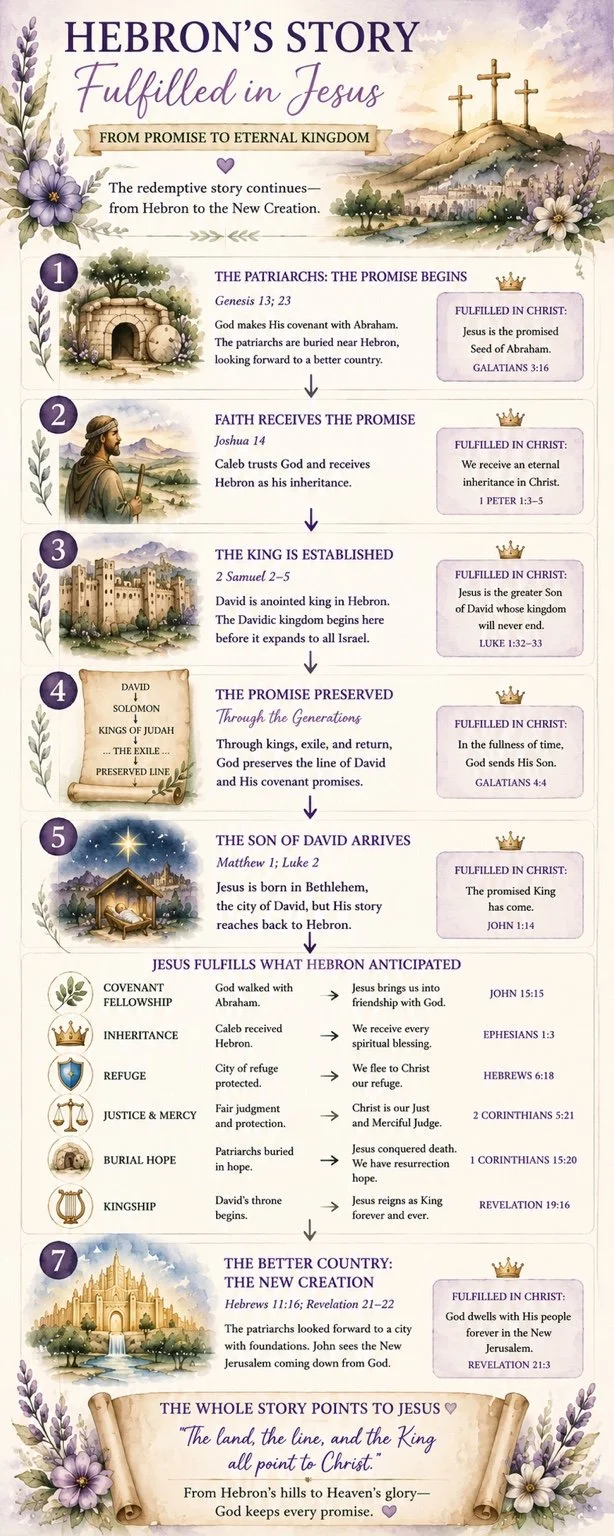
Feel free to print these out for your bible
