

Stones That Still Cry Out
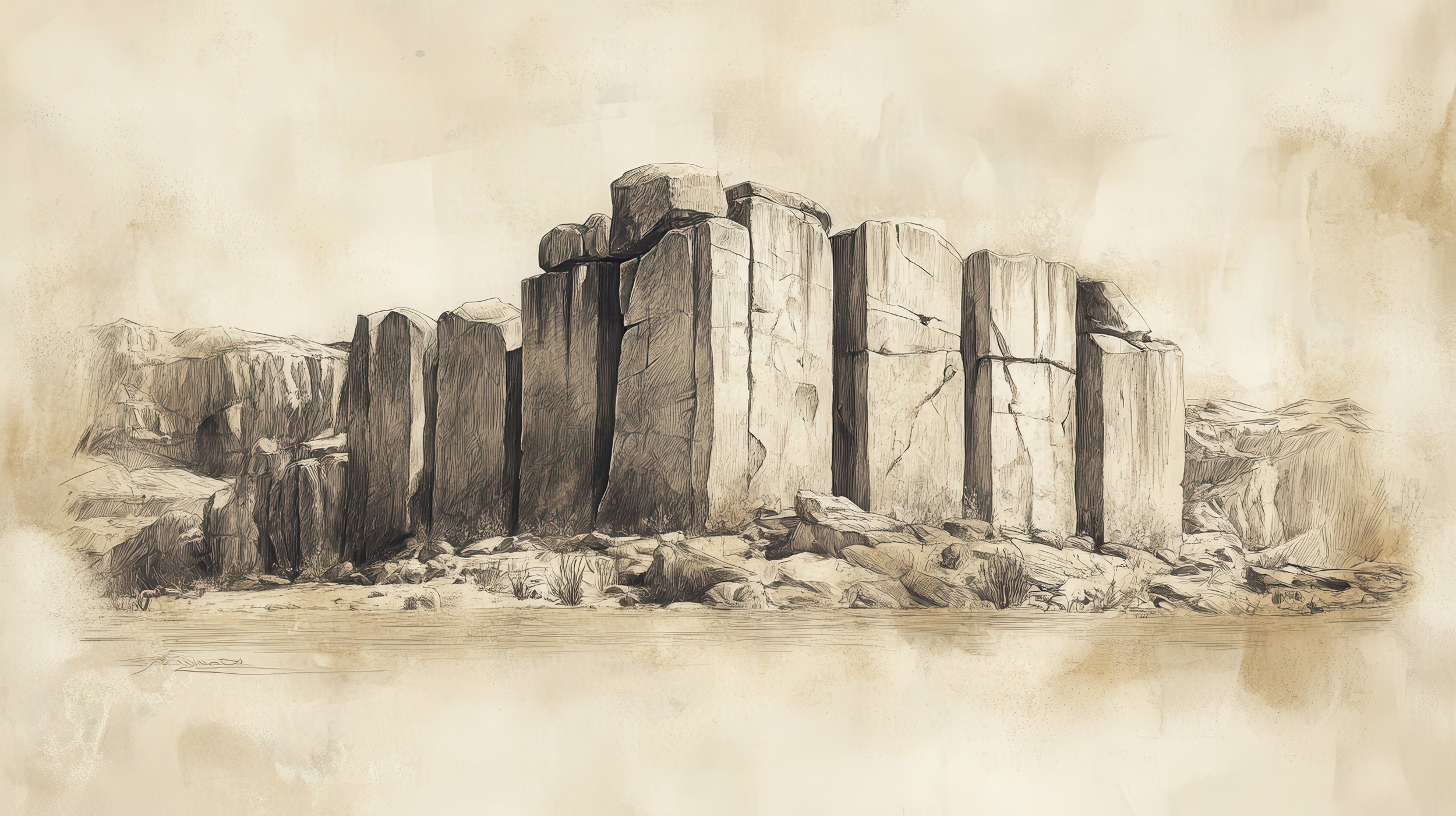
The twelve-stone memorial standing tall by the Jordan River, a testament to God’s power and faithfulness
I want to tell you how this blog post came to me, because the how is part of it.
I was sitting at The Quiet Table, and before I read a single word I prayed .asking the Holy Spirit to teach me, the way I always do. I wasn't hunting for anything new. I was simply reading slowly through the crossing of the Jordan. But the further I read, the more things began to sound familiar. A phrase here would echo something from there. A pattern would surface, and then another, each one seeming to pull up the next. And somewhere in that slow, prayerful reading, a small detail I had passed over a dozen times finally stopped me: there were two sets of stones. Not one memorial, but two. Once I saw it, I couldn't unsee what they were quietly preaching. Come sit with me, and let me show you what He showed me.
The Ark in the Waters
To feel the weight of the stones, you have to start with the ark.
The ark of the covenant was never God shut inside a box. It was the appointed place where His presence met His people—"There I will meet with you... from between the two cherubim" (Exodus 25:22). The whole purpose of the tabernacle, with the ark at its heart, was God dwelling in the midst of His people: "Let them make me a sanctuary, that I may dwell in their midst" (Exodus 25:8).
So when Israel came to the Jordan at flood stage—the river overflowing all its banks, at its most dangerous, most death-like—watch what God did. The priests carried the ark into the riverbed and stood firm on dry ground in the middle of the Jordan while all Israel passed over, and they stayed there until the whole nation had finished crossing (Joshua 3:17). The ark of God's presence went in first and came out last. It took its stand in the very place the waters would come crashing back down—holding death at bay until every last person was safely through.
Hold onto that picture, because everything else hangs on it: the presence of God taking its stand in the place of death so the people can pass over into life.
The True Joshua
Here is something easy to miss in English. Joshua and Jesus are the same name—Yeshua. When the Hebrew name was carried into Greek it became Iēsous, and into English, Jesus. They both mean "The Lord is salvation." The first Joshua led Israel through the Jordan into the land. And centuries later, the true Joshua stepped into that same Jordan.
But notice the beautiful difference. In Joshua's day, the people were kept out of the waters—they crossed on dry ground, spared, while the ark bore the place of death for them. At His baptism, Jesus does the opposite. He goes down into the water. He doesn't hold the waters off Himself; He steps in, standing with sinners though He had no sin of His own. That baptism opened His ministry and pointed ahead to a deeper baptism He spoke of: "I have a baptism to be baptized with, and how distressed I am until it is accomplished" (Luke 12:50). That baptism was the cross—where He went fully under the waters of death and rose again, holding them back for everyone joined to Him. "We were buried with him by baptism into death... so that we too might walk in newness of life" (Romans 6:4).
Two Sets of Stones, Two Builders
This is the detail that stopped me. There are two sets of twelve stones in Joshua 4—and once you see who builds each one, the whole picture opens up.
The twelve men, one from each tribe, were commanded to take twelve stones out of the middle of the Jordan—from the very place the priests stood with the ark—and carry them up and out to Gilgal on the promised side (Joshua 4:4–8, 20). And then Joshua himself set up twelve stones in the middle of the Jordan, in the place where the priests' feet had stood, where death was held back. The text names him alone as the builder of that one, and says the stones were "there to this day" (Joshua 4:9).
So the two sets move in opposite directions, built by two different hands. The tribes carry their stones up out of the deep onto the promise land. Joshua plants his stones down in the place of death. Stones in the deep, stones raised onto the land of promise—a buried-and-raised pattern written in granite, long before it was ever written in flesh.
And here is the part that took my breath away. Joshua—Yeshua, the very name Jesus would carry—is the one who sets the stones in the place where death was held back. He is the leader who stands the witness in the waters. And what that shadow points to is the surest truth in all of Scripture: Jesus did not send us into death. He went in Himself. "For our sake he made him to be sin who knew no sin" (2 Corinthians 5:21). "He himself bore our sins in his body on the tree" (1 Peter 2:24). Joshua in the riverbed is a quiet foreshadowing of the One who would stand in death's place for His people.
And the tribes? They carry their stones out to Gilgal as a testimony—the text says so plainly: "that this may be a sign among you, that when your children ask... you shall tell them" (Joshua 4:6–7). The people brought through death into the promised land, carrying the witness of what God did. That is the church, to this very day.
I want to be honest with you about where the text speaks plainly and where I'm reaching in faith, because that honesty is part of handling His Word with care. Scripture tells us Joshua set up the stones in the Jordan; it doesn't actually describe him carrying them down into the place of death as a deliberate descent. That downward, "took it upon Himself" motion is the deeper layer I'm seeing—not a detail the verse spells out. The text doesn't even tell us God commanded that second monument; as Warren Wiersbe carefully puts it, "it's likely that He did." But the truth this picture points to—Jesus bearing our death—is stated plainly all through the New Testament. So we can hold this with full confidence. It rests on the cross, not on a gap in the story.
Stones Built to Make Us Ask
God gave the stones a purpose, and He stated it twice: they were meant to make the children ask. "When your children ask in time to come, 'What do these stones mean?' then you shall tell them" how the waters were cut off before the ark of the Lord (Joshua 4:6–7, 21–22).
They were never set up to be admired. They were set up to provoke a question—and the question opens the door to retelling the story, so that God's faithfulness doesn't die with the generation that saw it. And what were the children to be told? Not how brave Israel was. They were to be told that the waters were cut off before the ark—that the presence of God is what brought them through.
Then think of what Jesus said: if the people kept silent, "the stones would cry out" (Luke 19:40). The stones have a voice. And the stones at Gilgal had been crying out since the day they were stacked, testifying to what God did, foreshadowing resurrection life out of the place of death. Jesus was saying, in effect, I am what those stones have been pointing to all along.
First the Physical, Then the Spiritual
This is the principle that ties it all together: "It is not the spiritual that is first but the natural, and then the spiritual" (1 Corinthians 15:46). God gives the physical first—as something real and true in its own right—and then unveils the spiritual reality it was always shaped to carry.
The ark was a real object. The crossing really happened. The stones really stood—both Joshua's set in the river and the tribes' set at Gilgal. We don't need to dig them up today for the meaning to hold; the witness was always meant to live in the telling more than in the rocks. But they were real, and that reality is exactly what lets them carry weight. The shadow came first; the substance came after. The natural Joshua led Israel through real water into a real inheritance—and afterward the spiritual Joshua leads His people through death into resurrection life. One Author wrote the whole story, and He was telling one story from the beginning.
And I love that I'm not the first to see the burial in those river-stones. Warren Wiersbe reads the hidden monument the same way—the stones buried in the depths of the Jordan picturing the old life buried, so that we now "walk in newness of life" (Romans 6:1–4). He even imagines a parent telling a child: there is another monument in the middle of the river where the priests stood—you can't see it, but it's there—a reminder that the old life has been buried and a new life begun. The shape I found in the stones is one trusted teachers found there long before me.
The Tribes Live On
And here is where it all comes home. Though there is no archeological proof today these stones existed, the twelve tribes those stones represented are not gone.
In Christ, we have been made "Abraham's offspring, heirs according to promise" (Galatians 3:29). We who were once not a people have been made "a chosen race, a royal priesthood, a holy nation, a people for his own possession" (1 Peter 2:9–10). And the miracle Paul marvels at is not two peoples kept side by side, but two made one: Christ "has made us both one" and created "one new man in place of the two" (Ephesians 2:14–15). Jew and Gentile—one new people in Him.
So the dead stones at Gilgal have become something greater. We are now "living stones... being built up as a spiritual house" (1 Peter 2:5). The heap that once stood as a silent witness has given way to a people who can speak. The stones have been crying out since Gilgal—and we are simply the ones now given a voice to say what they have always meant.
The presence of God took His stand in the waters of death so His people could pass over into life. The stones were set up so the story would be told. And here we are—His living stones—still telling it.
So let me leave you with the question those stones were built to provoke. When the people who come after you ask what God has done, what will you point to? What stones have you set up that you cannot stay silent about? Because the same God who told Israel to teach their children by a heap of stones is still raising up a people who refuse to keep quiet—and you are one of them.
